
“Growth Pull”: Lessons from Hyperliquid, Venice, and Canton
Crypto isn’t broken. Some things just don’t stick yet. A few systems seem to work differently. Here’s a simple loop that might explain why.

Beyond a few killer apps, crypto adoption has been brittle over the past few years. Too many products spike on incentives, then fade when rewards dry up. People try it, but don’t stick around. Growth stalls because it’s not spreading. And there aren’t many true believers pushing it forward. In practice, many product teams optimized for the surge, but not the retention.
Yet a few systems have transcended that loop. Hyperliquid grew TVL from about $2.0 billion to $4.1 billion, and cumulative perp volume from $617 billion to $3.55 trillion. Venice AI grew from 400,000 users to 2 million. Canton Network grew from 24 to 850 validators and $6 trillion in cumulative RWA flow.
These outlier systems turn use into juice, and make that juice compound. Strong hooks pull users in, good experiences keep them, and distribution begins stacking on itself.
Ideas old as time, yet easier said than done.
A simple name helps. Call it Growth Pull. Users come for a job to be done. The system gives them a reason to stay. Then it gives them a reason to care more. The best loops convert activity into aligned upside, and aligned upside into better liquidity, access, or coordination. Growth stops being borrowed and becomes self-reinforcing.
This post tries to distill a pattern I’ve noticed, into a simple five-stage loop.
- Hook - core action, immediate benefit
- Ignition - initial distribution sparks network effects
- Gravity - deepens engagement, increases user value
- Integrity - reinforces reliability, fairness, trust
- Scale - expands reach and adoption through new channels/integrations
I’ve been studying and sharing growth loops at @0xJMG. This post focuses on early-stage bootstrapping loops, not long term durability and builds on the earlier sensemaking work from Sarah Tavel, Lenny Rachitsky, and Andrew Chen - check them out. Early loops aren’t forever. Google and Facebook rewired theirs frequently as they scaled.
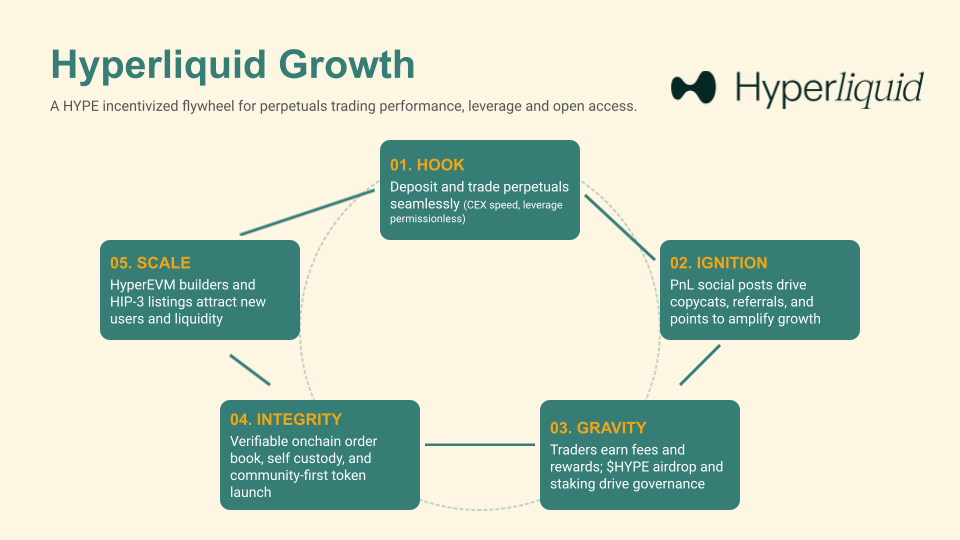
Hyperliquid is retail at full power. Users trade perpetuals with CEX-like speed, deep liquidity, leverage without giving up permissionless access. The hook lands instantly. It delivers what traders thought was out of reach.
Then the growth loop kicked in. Share PnL, invite friends, collect points, and the most committed stack in the HYPE airdrop and fee discounts. That sequence turned trading into social proof and social proof into distribution. Referrals and PnL screenshots became free billboards across social media. The platform benefitted as users had a reason to show their work. In 2025, Hyperliquid’s network revenue rose from about $10 million to $884 million. Monthly active wallets went from 61,000 to 291,000. Month 3 retention averaged about 21.1%, and month 6 about 11.6%, several times higher than venues like Drift or Curve to name a few.
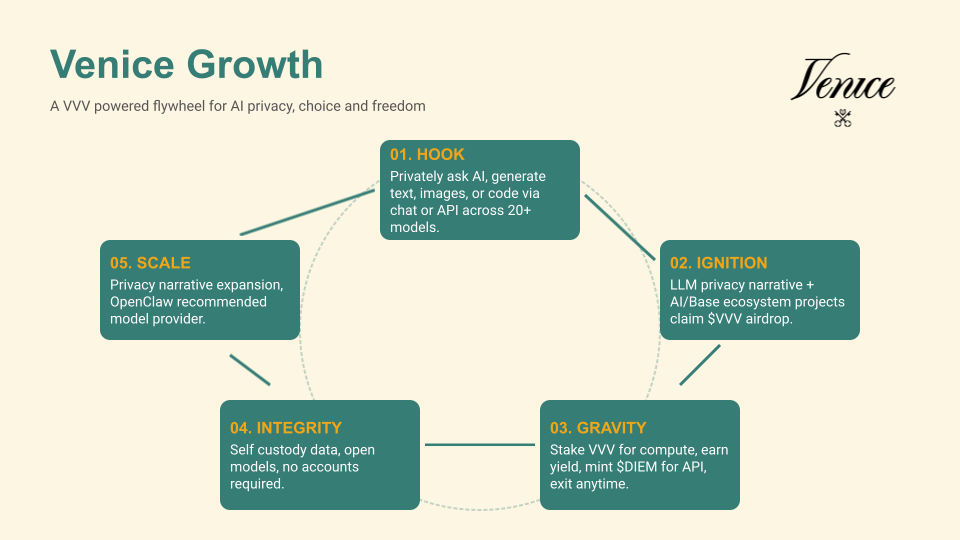
Venice solved a different problem. Its hook was private, uncensored AI. That tapped into growing frustration in the AI stack. Builders and users want capability, but also privacy and independence. Venice paired that demand with a token access model. Users could stake VVV for premium access, mint DIEM for API usage, and remain exposed to the network’s upside. The product felt less like a subscription and more like a stake at the table.
AI usage usually accrues value upward to the platform. Venice bends that value back to participants. Usage kicks off ownership, and ownership reinforces usage. Venice reported registered users grew from about 400K in Jan 2025 to 2M by Feb 2026. The network reached ~170M API calls in 2025. Around 68% of VVV supply was staked by March 2026, earning yield. These compounding metrics point to a reinforcing behavioral loop.
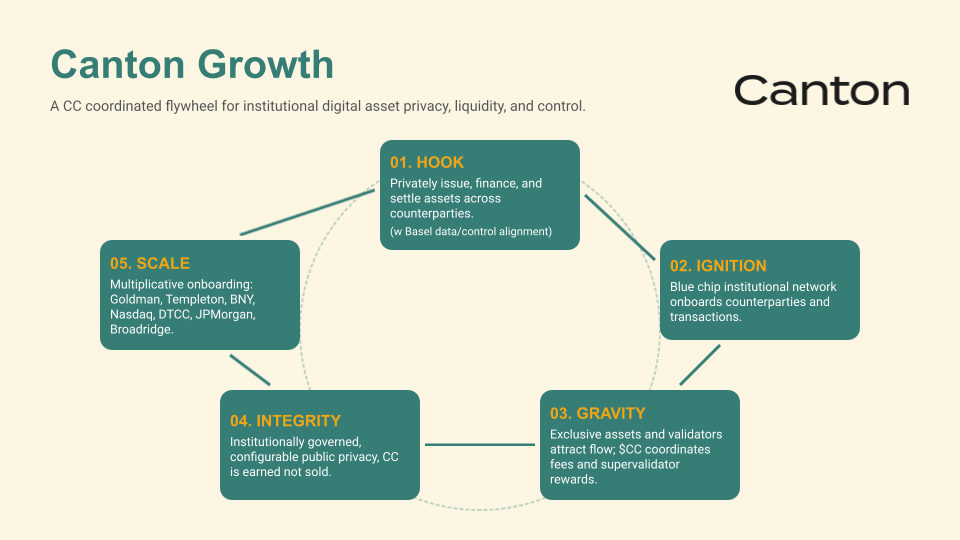
Canton shows a similar pattern in institutional form. Canton’s hook is private, regulatory-aligned coordination for issuing, financing, moving and settling digital assets. Institutions adopt when systems feel reliable and counterparties are already there.
Its growth loop compounds through counterparties, assets, and validator participation. More assets attract more institutions. More institutions attract more counterparties. More coordination drives more fees, more validator economics, and more reasons to deepen involvement. Canton reported cumulative RWA volume rose from about $3.6 billion to $6.0 billion. Daily active wallets rose from roughly 30 to 27,000, then to 77,000 by March 2026. Daily fees burned are sitting around $1.5 million to $1.7 million. Super validators grew from 17 to 43. The investor and partner roster includes firms like DTCC, Nasdaq, Broadridge, BNY, and Goldman. This is crypto growth through embedded institutional gravity.
So what connects these three? Hyperliquid pairs performance and access with ownership. Venice pairs private AI utility with ownership. Canton pairs institutional coordination with ownership-like participation and economic alignment. None offer full ownership, but the degrees do matter. Each system automates alignment, coordination, and incentives. Each starts with a clear hook, builds value, earns trust, then grows while retaining what it creates. The loop keeps going.
These outliers follow a pattern. Start with a simple hook people want. Make it easy to spread. Make it better with each user. Make it rewarding to stay. Scale without leaking value.
Hook. Ignition. Gravity. Integrity. Scale.
That is Growth Pull. Done right, systems compound faster, ownership spreads, and attention amplifies what nourishes the loop.
This post uses public data from DefiLlama, Token Terminal, and respective project's self reporting. Corrections welcome. Not investment advice. Some Hyperliquid, Venice, and Canton parts are private, and risks may not be visible. No risk assessment was performed.