
Who Owns What? A Look at Token Rights, Disclosure and Enforceability
Under the microscope with new token frameworks from Aragon, Blockworks, DefiLlama, and ideas for the adoption path ahead
Many tokens suggest ownership, but few deliver it.
When things break, holders quickly realize control sits elsewhere and their rights are limited or unclear. Millions of token projects have been created. Jeff Dorman argues fewer than 20 are investable where traction and value capture draw the line.
To understand traction and value capture, we need to look deeper, because if projects promise a more distributed and fair future and expect talent and capital to organize around it, those claims should be verifiable.
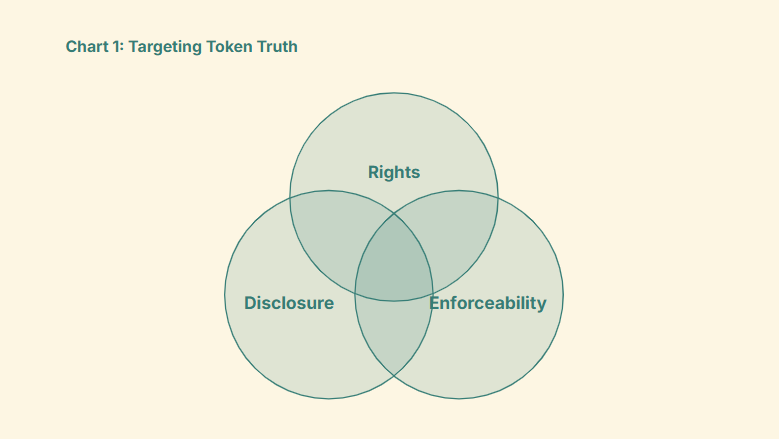
This post examines the current landscape of token rights, disclosure, and enforceability, and offers ideas to compound transparency and ownership going forward.
The Cost of Illusion
Blockchains promised openness and new forms of control. We got some, along with new layers of confusion and extraction.
First, the utility illusion.
Most tokens are launched too early and sit outside the core product-market fit loop. They don’t drive sustainable usage or capture value and end up being just exit liquidity instead.
Second, the risk illusion.
When control structure is hidden, only a few people can evaluate it. That limits scrutiny and concentrates risk. We’ve seen this with KelpDAO’s verifier setup and Step Finance’s key compromise to name a few.
When the control structure is visible, more eyes can test and challenge it early. That doesn’t mean exposing individual signers or keys. It means showing the shape of security: how many independent parties are required, what checks exist, and whether any single actor can act alone.
Third, the ownership illusion.Perceived rights diverge from actual control.
Most founders start with good intent, but conflict and pressure push decisions toward short-term survival, and the system strays. Last year was a wake-up call on who really owns what.
Circle acquired Axelar’s team and IP, leaving AXL holders out. Aave DAO conflicts pushed out ACI, BGD, and Chaos Labs, shrinking distributed professional oversight. Coinbase acquired Vector.fun while TNSR holders were left with souvenir coins.
These outcomes may be good or bad depending on your perspective. The point is different: many tokenholders understood the situation differently than it played out.
These aren’t rare cases. They’re just the ones that surfaced and reveal a deep gap between belief and enforceable power.
Soon the Digital Asset Market Clarity Act will codify minimum disclosure requirements on control, decentralization, related-party deals, IP and offchain ownership, and supply mechanics. But there’s no reason to wait for the minimum standard.
Three Ways to See Rights, Disclosure and Enforceability Today
The tools to fix this have arrived, yet adoption is somewhere near the crawl-walk stage.
Aragon’s Ownership Token Framework (OTF) reads the code. It verifies what rights are actually enforceable onchain.
Blockworks’ Token Transparency Framework (TTF) reads disclosures. It shows what teams choose to reveal about structure, supply, and relationships.
DefiLlama’s Token Rights Framework (TRF) maps governance, economics, and ownership into a structured lens.
Chart 1: Overview
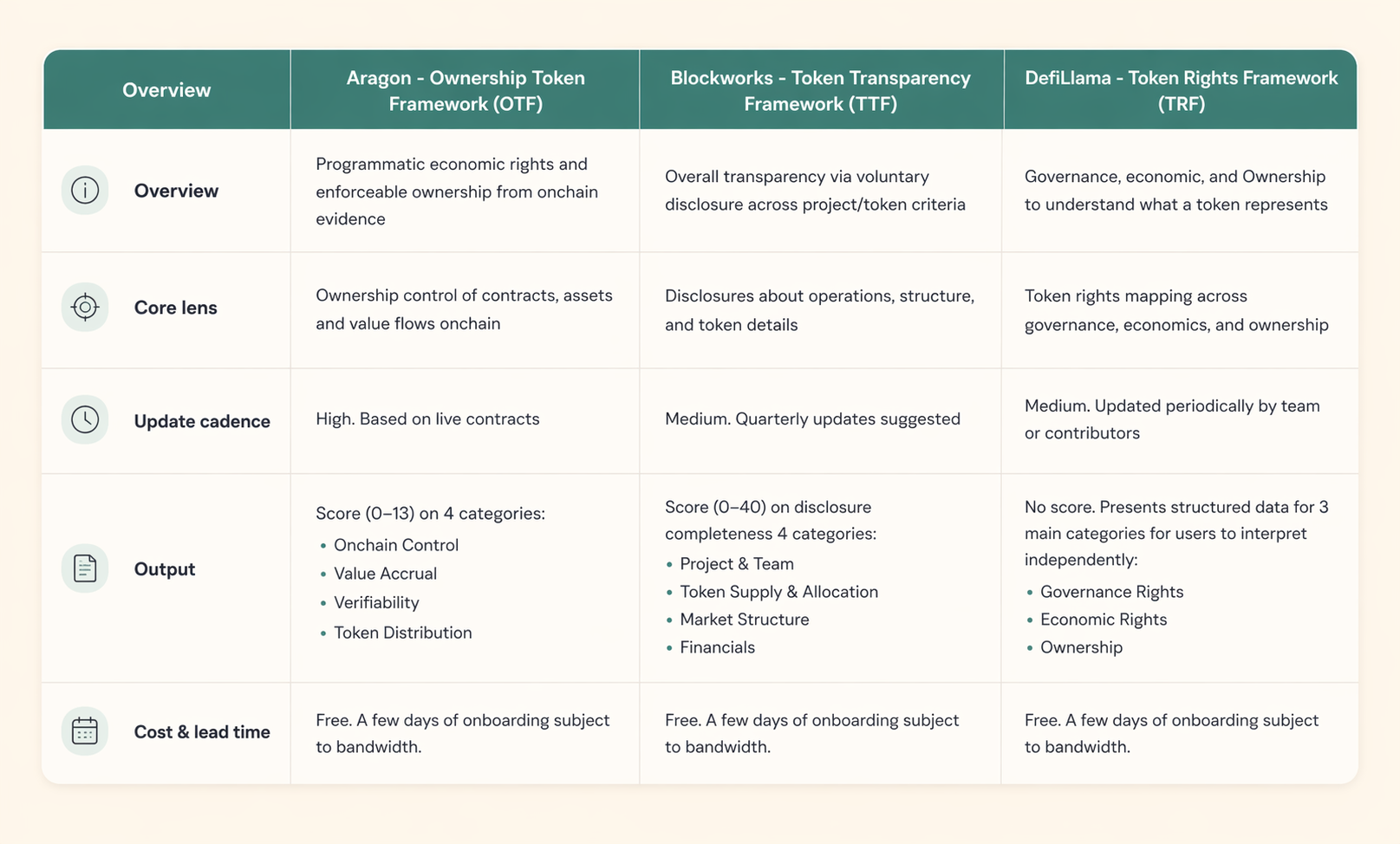
High level, Aragon offers the strongest onchain verification and integrity with a clean UI, but requires more effort and can have incomplete fields.
DefiLlama sits in the middle with simple, structured inputs embedded in a rich data ecosystem, though verification is lighter and the UI may overwhelm institutions.
Closing it out, Blockworks relies on voluntary disclosures, highlighting teams that actively prioritize transparency. Its strong media and events distribution amplifies visibility. The experience starts clean, but tails into dated-feeling PDFs.
Which one works best depends on what you value. Most importantly, all three agree transparency and ownership matter.
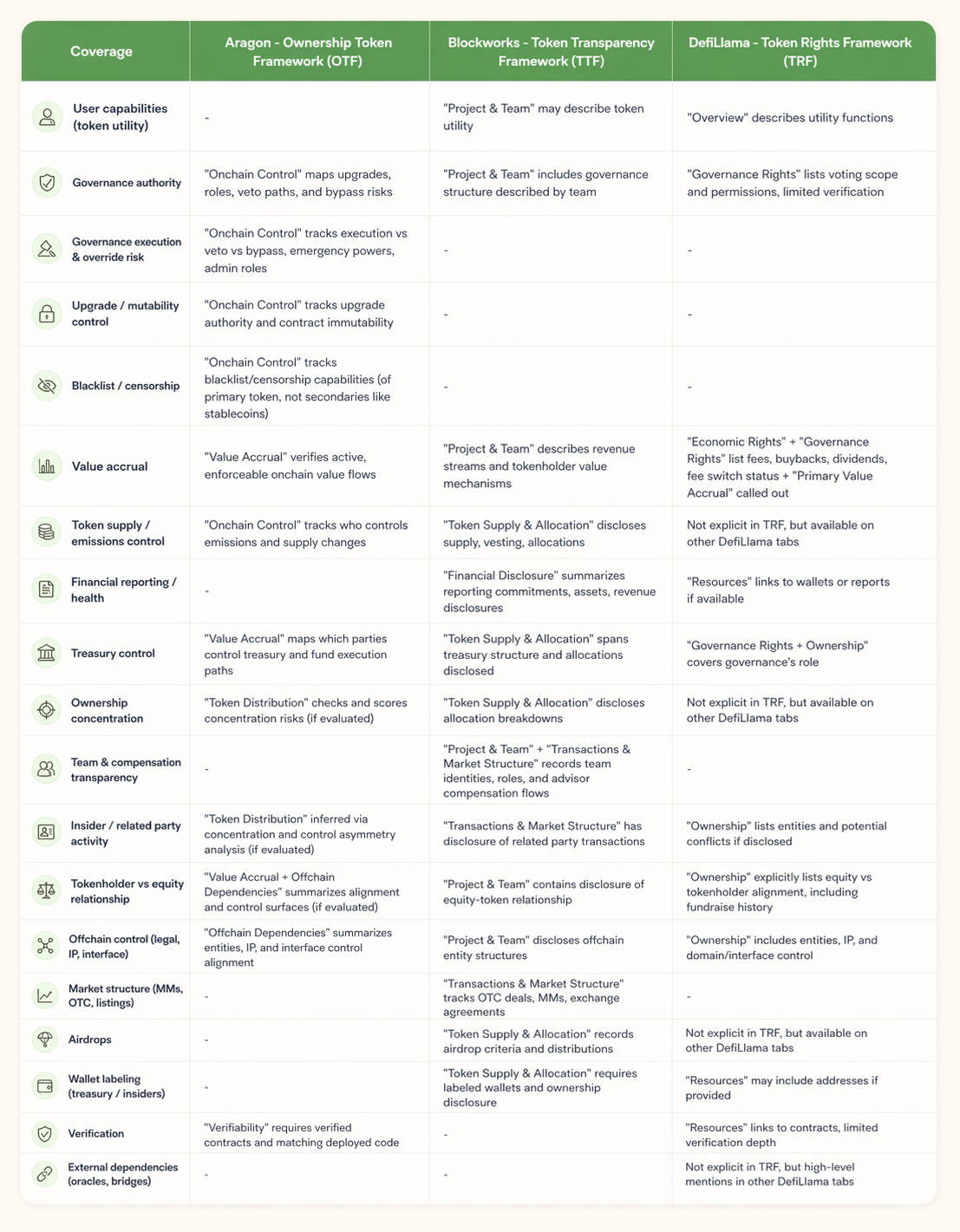
Side by side, a few important distinctions are more noticeable.
Chart 2: Detailed Comparison Table.
Scores Hide Risk?
Aragon and Blockworks frameworks summarize results with scores.
Aragon uses a 0–13 score to measure what a token can enforce onchain, focusing on control, value capture, verifiability, and distribution.
Blockworks uses a 0–40 score across ~18 disclosure items, covering team, token supply, financials, and market structure.
At first glance, this feels helpful because a single number simplifies complexity and enables comparison, but it also compresses nuance.
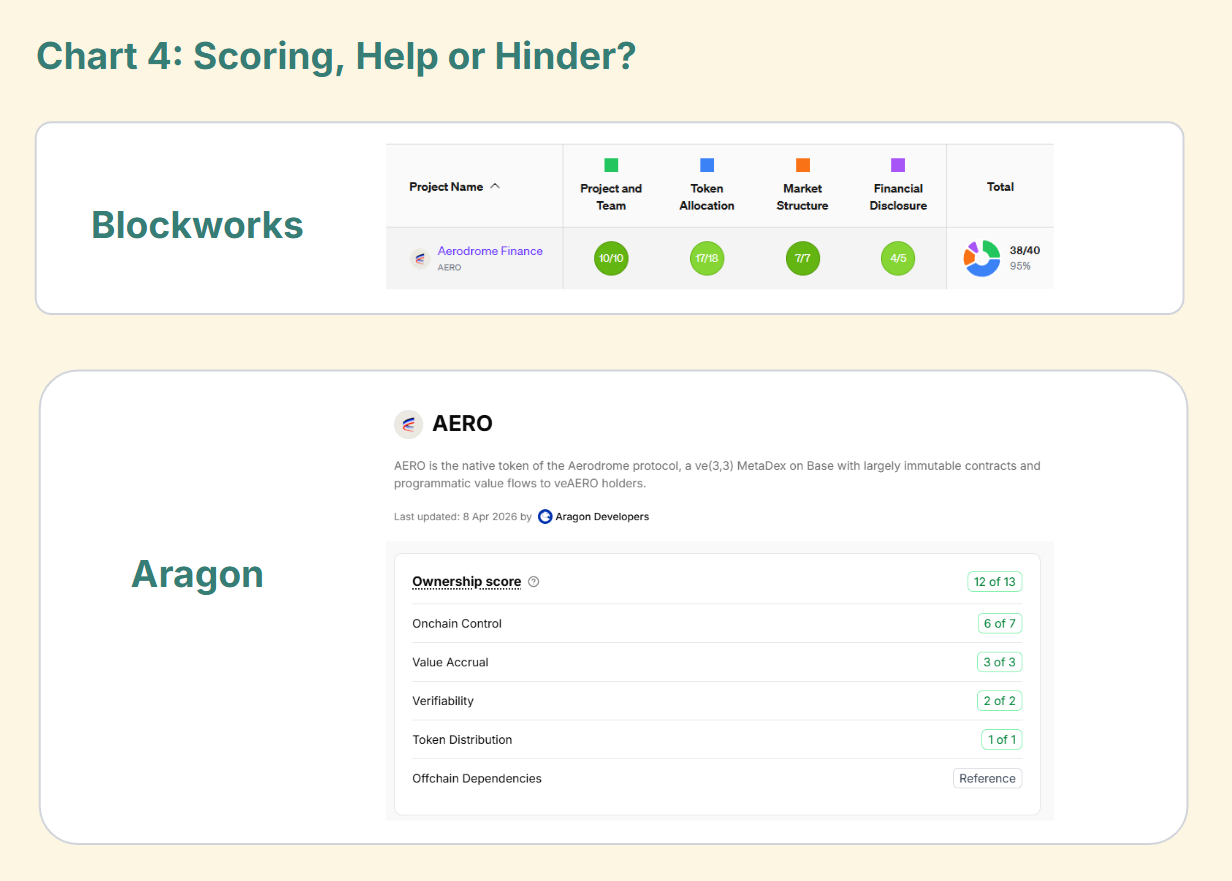
Poorly understood scores can create false confidence. In 2008, “AAA” ratings masked toxic mortgages and helped trigger a systemic collapse. FICO masks the danger of over-leveraged elites while locking millions of reliable "thin-file" humans out of the economy.
New scoring models also slow adoption given the learning curve and a lack of shared standards.
There are exceptions. A 0–100 scale (e..g. Consumer Reports) works like a cheat code because many already understand it from grades, cents in a dollar, and years in a century.
DefiLlama avoids scoring. The ethos at DefiLlama is to present the observable facts and let the user score and weight based on what they care about. Take a look at DefiLlama’s Aerodrome token rights here compared to Blockworks and Aragon in Chart 4 above..
In my forensic accounting formative years, we lived in GAAP accounting, SEC filings, and company documents. We had scoring systems too, but specific to our own biases. Rarely did two analysts score the same facts the same way.
Custom scoring feels too early for blockchain systems, when we need to get the ground truth right first.
Yes or No Truth
Clarity can accelerate when answers are binary. “Yes” or “no” shifts the burden to projects to meet clear standards and helps remove interpretation drift.
Binary disclosures with linked rationales can achieve much of the mental shortcut desired from the scoring system. They let the user decide what's more valuable to them without the learning curve
Here are five example questions better suited with a binary format (+ more in the addendum):
- Y/N - Do tokenholders control supply and emissions?
- Y/N - Do tokenholders control treasury allocations and strategy?
- Y/N - Is protocol core logic executed transparently onchain?
- Y/N - Is the token censorship-resistant (cannot be blacklisted)?
- Y/N - Is team ownership below 25% of tokens?
Chart 5 is a look at EtherFi’s treasury, through 4 different approaches.
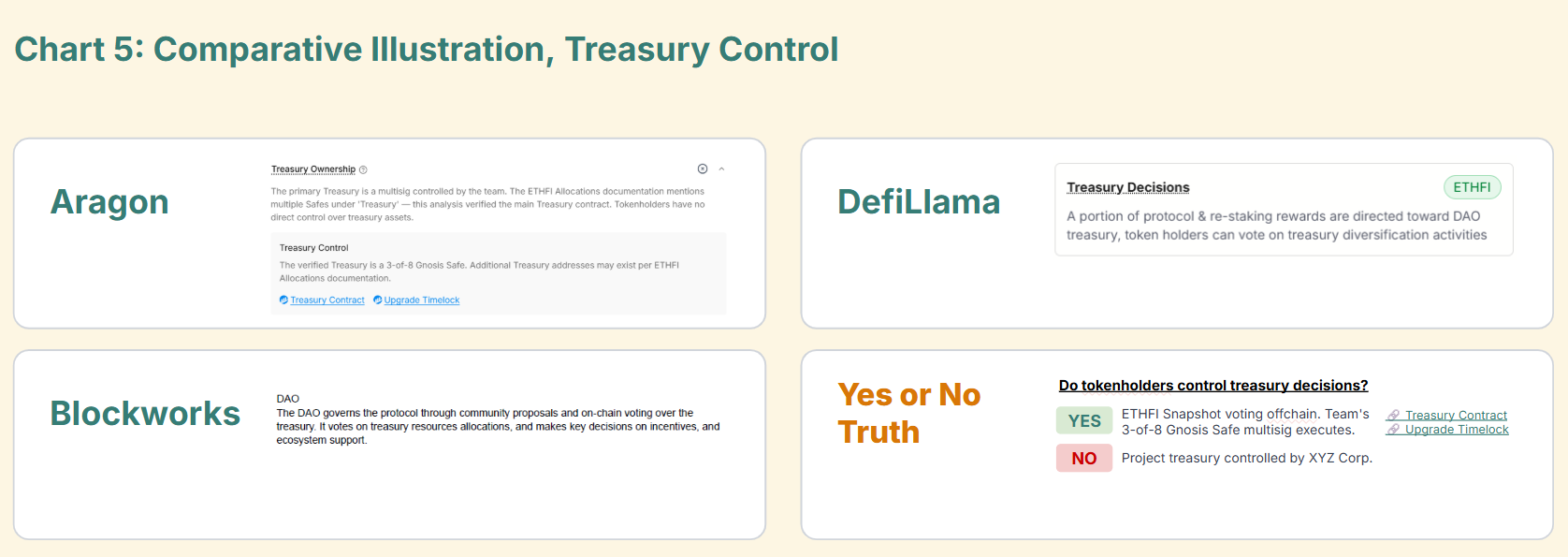
Imagine scanning 20+ fields on one screen. What helps you “get it” faster?
Each answer should include proof: contracts, wallets, or documents. No proof should default to “no.”
Make Trust Portable
Even with better disclosures, one problem remains: distribution. If information is hard to find or interpret, it won’t scale.
Other industries solve this with simple, recognizable badges that make trust portable.
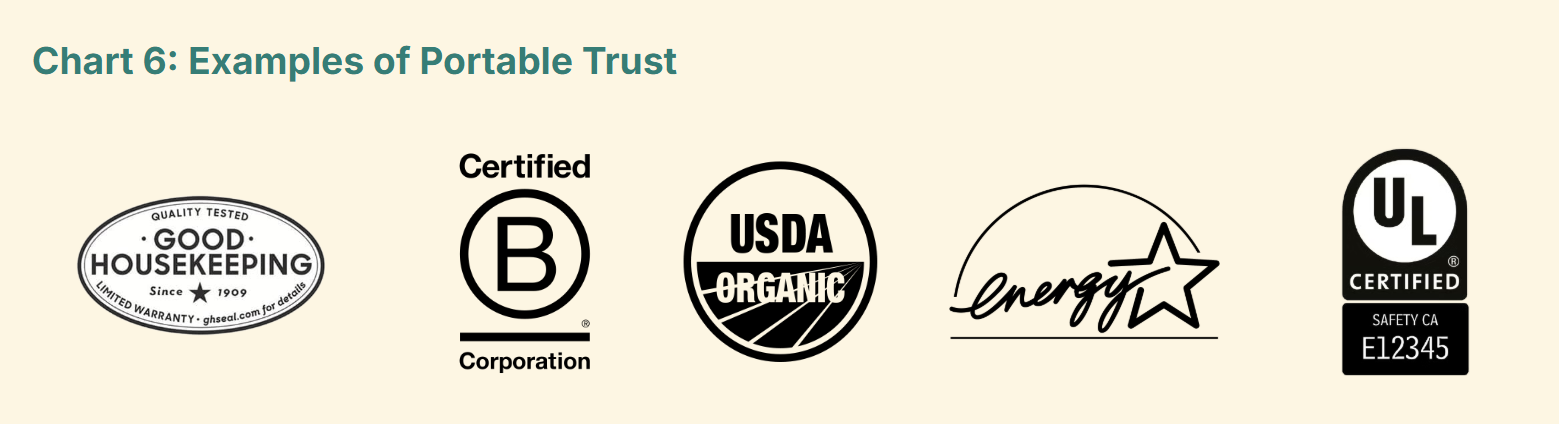
- Good Housekeeping (1909): ~5,000 yearly; product badge testing and guarantee
- Certified B Corp (2006): ~10,000 firms; company badge signaling profits with purpose
- USDA Organic (2002): $100B market; food badge marks food grown without synthetic inputs
- Energy Star (1992): 80% American households; appliance badge, highlights top-tier efficiency
- UL Mark (1905): 22B yearly; parts badge certifies safety through pass/fail testing
The pattern is a clear standard, verifiable criteria, and broad distribution. Our industry lacks this.
A simple, portable mark tied to rights, disclosure and enforceability could travel across exchanges, wallets, and data platforms. It could sit next to a token everywhere it appears.
Not as marketing, but as a pointer to truth.
Let Users Shape the System
Standards improve when participants help shape them.
A nominal submission fee can fund a small treasury for ongoing bounties. Every decision is public, verifiable, and incentivized for truth. Anyone can flag issues. Higher-signal contributions can stake stablecoins for priority, with slashing for bad actors.
A predictable participative loop can support this:
submit → review → accept/reject → appeal → publish → public bounty → repeat
Long term, a co-op model could govern it, similar to the early Visa card network, but with Aragon, DeFiLlama, Blockworks, exchanges, and wallets as the guiding tenants.
Where This Leads
We’re still struggling with errors, exploits, and scams, but much of it is avoidable. We’re working with the most powerful tools for transparency ever created. If we apply them well, they snowball and become unstoppable.
Token projects need to make transparency table stakes, not just for postmortems.
Appreciation to Aragon, Blockworks, and DefiLlama for pushing their visions forward. Keep going. The next step is coordination: turning different maps into one compass.
That’s it for now. If I missed something or got it wrong, let me know on 𝕏.
===============================================
Addendum:
After reviewing the three frameworks, a few additional areas stood out that may be worth considering. I haven’t gone deep on each, but the ideas are here for the taking.
Binary yes or no truth questions:
- Do tokenholders control fees? Y/N + links
- Do tokenholders control incentives? Y/N + links
- Do tokenholders control buybacks? Y/N + links
- Do tokenholders control the project’s IP? Y/N + links
- Do tokenholders control the project’s frontends? Y/N + links
- Do tokenholders control protocol changes? Y/N + links
- Are the protocol-issued assets (stablecoins, etc.) censorship-resistant (cannot be blacklisted)? Y/N + links (consider Pharos blacklist tracker integration)
- Do cross-chain messages require multiple independent verifiers? Y/N + links
- Do user fund movements require approvals from outside the core team? Y/N + links
Other potential questions:
- System circuit breakers?
- Audit status with links?
- Risk disclosures: exploits, litigation?
- Revenue quality: organic vs incentives?
- Liquidity dependence: organic vs incentives?
- Governance activity (12-month volume)?
- Oracle dependency and control risk?